



John Nicholson & Sons

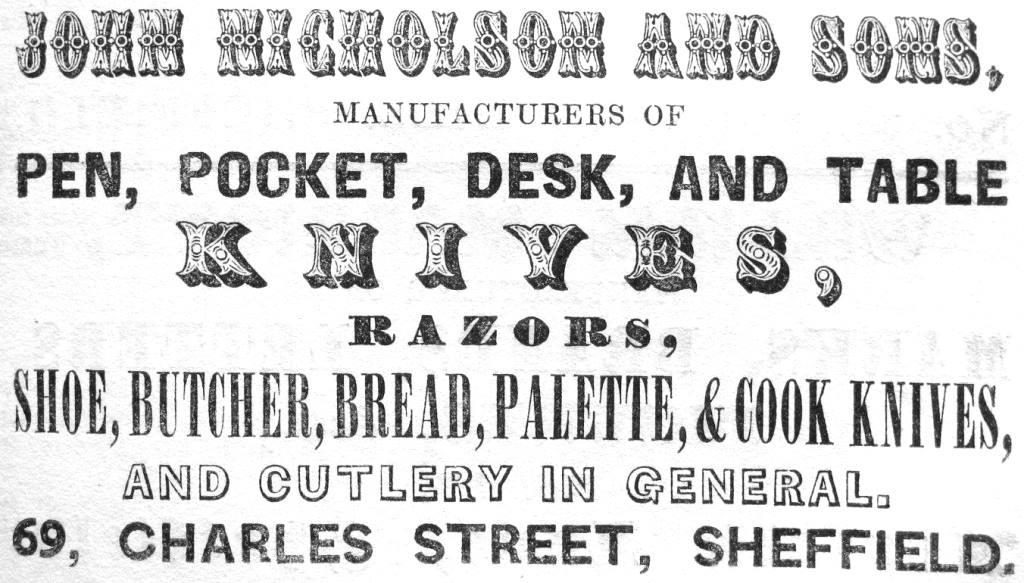
Business card, c1890; SCC Picture Sheffield (arc01905)
This branch of the Nicholson family came from Attercliffe. John Nicholson (c.1733-1801) was a cutler, who in 1754 married Hephzibah Wadsworth. Both the Nicholsons and particularly the Wadsworths had been involved in the establishment of Sheffield’s first dissenting church at Attercliffe in 1676. This later attracted the interest of antiquarians, such as Robert E. Leader (Reminiscences of Old Sheffield, 1876), and various contributors to The Sheffield Independent (19 September, 22 October 1872; 16, 23, 30 November 1874; 20 May 1875). They published details on the two families, though the information is somewhat incomplete regarding cutlery. A Directory of Sheffield (1787) listed John Nicholson as a pen-knife cutler at Darnall, using the trademark ‘SAX’. He is known to have moved to Sheffield, which would explain his appearance in a directory in 1797 at Broad Street, Park. He died on 30 January 1801, aged 68, and was interred at Attercliffe Chapel. His son, Matthew (c.1767-1800), had been buried there in the preceding year. John and Hephzibah had five daughters and at least one more son: John (c.1765-1809). Interestingly, both John and Matthew became Freemen in 1791 (the same year as another Freeman, William Nicholson, who was the son of a John Nicholson).
In 1788, John Nicholson married Sarah Staniforth and they had three sons: John (1790-1861), Matthew (1798-1840), and William (1803-1879). John Sen. apparently died in 1809 and was buried at the parish church on 17 December. His three sons became cutlers. John, who was to establish John Nicholson & Sons, was listed in 1816 as a a pen and pocket knife manufacturer at Pond Street. (It should be noted that William & Thomas Nicholson, table knife makers, had been listed at Pond Street in 1797, using the mark ‘NICHOLSON’. But their identity is uncertain and they dissolved their partnership in 1802.). By the early 1830s, John was partner with his brother, Matthew, at Pond Street. By 1839, they were pen, pocket and Chinese lock-knife and cutlery manufacturers at Suffolk Road. Confusingly, Nicholson & Loy was also active in the 1820s. So, too, another John Nicholson at Radford Street.
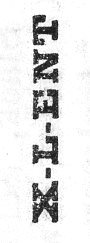
In 1840, J. & M. Nicholson was bankrupt. An auction was arranged at Norfolk Place of its stock of fine cutlery (including eleven hundred dozens of pen and pocket knives and a hundred pattern cards); and its warehouse fittings and working tools, which included sixty cutlers’ vices (Sheffield Independent, 21 March 1840). Matthew died at Arundel Street on 30 April 1840, aged 41, ‘after a severe indisposition’ (Sheffield Independent, 2 May 1840). Apparently, he died of consumption. He was buried at the parish church. His wife, Maria (d. 1851), continued to keep a beerhouse. Their sons included John Clayton (1826-1891) and Matthew Charles (1840-1905). John Nicholson resumed trading after the bankruptcy. By 1841, he was a spring knife manufacturer in St Thomas Street. John lived with his wife Martha née Jow and sons John (1812-1839), William (1818-1891), James (1824-1909), Matthew Henry (1828-1913), and Samuel (1831-1870). The sons, except the youngest, John (who became a steel maker), were either being trained or were working as cutlers. In 1849, a Sheffield directory listed John Nicholson & Sons as a maker of pen, pocket, desk and table knives, razors, shoe, butcher, bread, palette, and cooks’ knives, and ‘cutlery in general’ in Charles Street. The directory carried an advertisement for the firm. It made Bowie knives for the American market, including a fine gold-washed example (etched ‘Gold Finder’) illustrated in Flayderman (2004)1. Adams et al (1990)2 also depicted a Nicholson Bowie knife that may have been made by this maker: it is etched ‘Good as Gold’, with the mark ‘XLENT’.
In about 1850, the company moved to Union Street Works. By 1854, it had begun steel making at Mowbray Steel Works, Mowbray Street. In that year, the partnership was dissolved: John, William, and James continued John Nicholson & Sons as a steel making enterprise in Mowbray Street. Matthew Henry Nicholson manufactured table knives under his own name in Union Street. John Nicholson, ‘steel merchant’, Spring Lane, died on 12 June 1861. He was aged 70 and was buried in unconsecrated ground in the General Cemetery. An impressive monument was erected over the grave by ‘four sons and one grandson’. He left under £2,000.
1. Flayderman, Norm, The Bowie Knife: Unsheathing an American Legend (Woonsocket, RI, 2004)
2. Adams, W, Voyles, J B, and Moss, T, The Antique Bowie Knife Book (Conyers, Georgia, 1990)