



Thomas Bell & Company
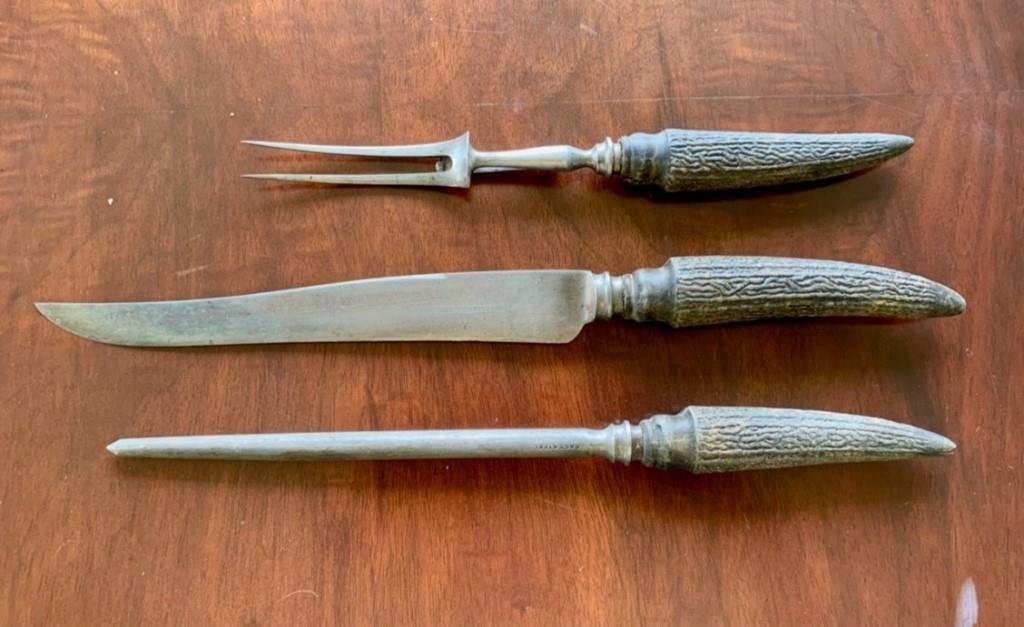
Thomas Bell carving set. Image courtesy of Dr Christine Castle, Whitby
This traditional carving set – carving knife, fork, and sharpening ‘steel’ – is marked ‘Thomas Bell & Co, Sheffield, England’. The knife is likely made from shear steel; the sharpener is marked ‘cast steel’. The set (in possession of Dr Christine Castle, of Whitby) would probably have been made in the late nineteenth century or before the First World War.
Shear steel – hand-forged from ‘cemented’ bar iron – was renowned for its cutting properties. The handles are made from horn – a material which was hard-wearing and used on best-quality Sheffield cutlery. However, this carving set may not have been marketed by a Sheffield manufacturer. ‘Thomas Bell & Co’ does not seem to have been listed in Sheffield directories. This suggests that, although the carving set was made in Sheffield, it was commissioned by a merchant or retailer.
There are two candidates. The first is Thomas Bell & Co, which was active from about the 1860s in the City of London. The firm was an export provision merchant and ships store contractor. The founder was Thomas Bell, who had been born in Ireland. He was later joined by his sons, Thomas Bell Jun. and Hugh Hill Bell (d.1923). The second candidate (and the likeliest) is Thomas Bell & Co, a Liverpool export house. The founder, Thomas Bell (1797-1876), was born in Scotland. By the 1850s, his business was based in Castle Street, Liverpool, and specialised in the South American trade. Thomas and his son – George Mackenzie Bell (1845-1895) – made a fortune. So, too, did James Watson Bell (1839-1917), a nephew of Thomas, who operated an office in Buenos Aires (his birthplace). Robert Robinson (1840-1930), another Liverpool merchant (who may have been apprenticed at Bell’s), married Thomas’s daughter, Mary Elizabeth Bell. She died within only a year of the marriage in 1871, aged 23. However, Robert Robinson eventually succeeded to the Bell business and at his death in 1930 was described as the senior partner (Liverpool Echo, 25 August 1930). He left £70,000. Thomas Bell & Co continued to trade in the 20th century.
Other carvings sets marked with the company’s name have appeared on auction sites, some with silver ferrules marked ‘GHB’ (possibly the mark of Sheffield silversmith George Henry Biggin, which would date those items to the early 1890s). Straight razors marked ‘Thomas Bell & Co’ have also survived.