



Blonk & Son
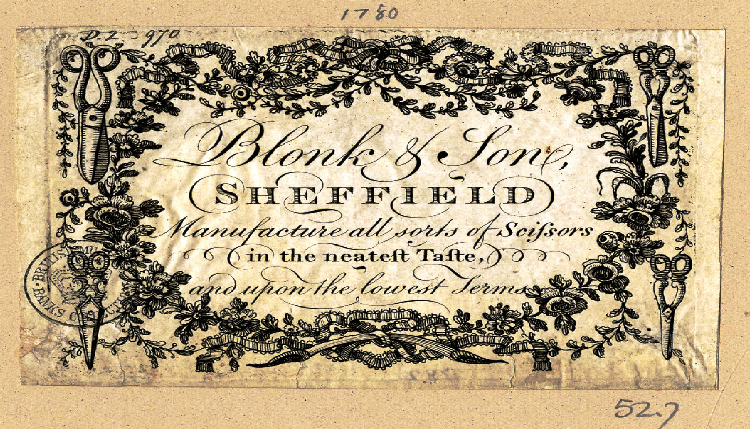
Blonk Street in the Wicker is named after this family of scissors smiths, who operated in the late eighteenth century. In 1774, William Blonk & Son was listed in the directory as a scissors maker and factor in Change Alley. The directory informed its readers: ‘These strike three marks’, which were ‘S’ letters and a Maltese cross. In 1779, Benjamin Blonk registered a silver mark as a plate worker in Change Alley. Possibly William was the father of Benjamin, who was apparently born in 1747. Bailey’s Northern Directory (1781) listed Benjamin Blonk & Co as fine scissors makers and factors in Surrey Street. Intriguingly, in 1785 Benjamin registered a patent for stamping or rolling scissors from a bar or plate of steel, using a stamp, fly or screw press, or by rolling with cylinders. By 1787, Blonk & Son was a scissors smith in Norfolk Street, using the letter ‘S’ to mark its products.
The Blonks prospered and George Blonk – possibly Benjamin’s brother – had a house in Cherry Tree Hill. The family also owned tilts in the Wicker, such as Castle Orchards Wheel (Ball et al, 20061). By the end of the eighteenth century, the Blonks had intermarried with the Silcock family. The result was Block, Silcock & Co, which was listed in 1797 in Norfolk Street as a merchant and factor. Benjamin Blonk, merchant, died on 23 January 1813 and was buried in St Paul’s churchyard. He was aged 67. According to his obituary, he had led a ‘life of strict honesty and integrity’. George Blonk, ‘scissors maker’, Cherry Tree Hill, died on 9 April 1813 and was buried in St James’s graveyard, aged 62. Blonk, Silcock & Co operated in Norfolk until at least 1822. Thereafter, William Silcock, merchant, traded alone in Norfolk Street. He lived at Whiteley Wood Hall, which had been built by Thomas Boulsover. William Silcock was buried in Ecclesall on 18 January 1827. Ward, Blonk & Co remained as forgers and tilters in Lady’s Bridge, Wicker, during the 1820s and 1830s.
Further reference to the Blonk family is made on the Sheffield History forum at https://www.sheffieldhistory.co.uk/forums/topic/15034-how-did-blonk-street-in-sheffield-get-it39s-name/
"A bit of Blonk history. William Blonk came from Cromwell in Notts. is son became a "Scissorsmith" as did successive generations. They owned or rented The Castle Orchard wheel and then expanded to The Wicker Wheel and The Wicker Tilt. The Blonk ownership of The Wicker Tilt gave the name to Blonk Street.
The Wicker Wheel and Tilt were leased to Blonk & Co from 1785. The 1771 map of Sheffield on the Picture Sheffield web site shows these two water wheel driven sites before there was a Blonk Street. The 1808 map on Picture Sheffield shows that Blonk Street has been created between the two factories leased to Blonk &Co. At this stage the bridge has not yet been built. By the time the 1838 map was drawn the bridge has over the Don has been built and carries Furnival Road over the Don to join Blonk Street at the end of the bridge. The Blonks bought the Wicker Tilt hammer Forge from The Norfolk Estate in 1811. At some time the Company became Silcock Blonk & Co. As well as partnership there was a marriage of a Blonk daughter to a Silcock. From 1861 Benjamin Blonk and then Francis Huntsman bought up the shares from the heirs of the Silcock Blonk partners. This is the reason for the initials on the Blonk street end of the bridge over the Don. The Wicker Wheel had been leased by Cocker and in 1895 was still using the water wheel but the Wicker tilts wheel was described as an "Ancient and obsolete wheel" so it is assumed steam was being used by then. The weir diverting water to the wheel and tilts can still be seen today through the eastern arch of Lady's Bridge giving rise to a saying I heard long ago "Down t'Wicker where T'water goes o'er t'weir."
1. Ball, Christine, Crossley, David, and Flavell, Neville (eds), Water Power on the Sheffield Rivers (Sheffield, 2nd revised edition, 2006)