



Graveley & Wreaks
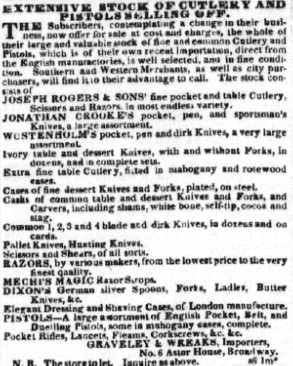
Advertisement in New York Morning Herald, 1838. Image courtesy of Geoff Tweedale
John Graveley and Charles Wreaks were merchants. Bowie knives marketed by these men have been a favourite (and mystery) among collectors. One is depicted in Flayderman (2004)1, with ivory grips, engraved German silver mounts, and the acid-etched slogan: ‘THE HUNTERS COMPANION / MY HORSE, KNIFE AND RIFLE’. As Flayderman noted, the knife is ‘of superb quality’. Graveley and Wreaks were in business in New York in the late 1830s, but almost nothing was known about them (Batson, 19962). This invited speculation about their origins and links with the Bowie knife. This Directory presents their biographies for the first time.
John Graveley and Charles Wreaks were English. Graveley was born in about 1798, near Leeds. Probably his birthplace was Halton, which was a small farming hamlet a few miles east of Leeds, where the Graveleys were part of the community. More is known about Charles Wreaks. He was born in Sheffield on 4 April 1804 and was later baptised at St Peter & St Paul parish church. Its registers provide details of his parents, and brothers and sisters. He was the son of Joseph Wreaks (bapt. 1770-1843), ‘merchant’, and his wife, Judith née Fernell (c.1776-1867). In 1826, Joseph became postmaster for Sheffield. He and Judith had several daughters – including Ellen (1802-1884), who succeeded her father as postmaster – and five sons: James Fernell (bapt. 1799), Henry (1801-1843), Charles (1804-1867), William Fernell (1805-1847), Joseph (1810-1888), and Richard (1810-?). James’s subsequent life is unknown, but the other brothers sought their fortunes in America as merchants.
Graveley apparently was already in America. A ship’s passenger list recorded his arrival in New York in 1821. He soon opened for business. He advertised in the New York Evening Post, 6 October 1825, as a dealer in hardware and cutlery in Maiden Lane. He sold a range of Sheffield cutlery, including pen knives by Joseph Rodgers & Sons. He then moved to Charleston in South Carolina. By 1830, Timmons & Graveley had been established at East Bay Street, Charleston, selling ironmongery and cutlery. Graveley’s partner was William Timmons (1773-1838). Meanwhile, Charles Wreaks had arrived in New York. A ship’s passenger list recorded him disembarking in New York in 1828 (possibly his first visit). His younger brother, Henry, was in New York in the previous year. Joseph made the trip across the Atlantic in 1830; and Richard was a New York resident by the 1830s. The four brothers became merchants: Charles, Henry, and Richard in New York; Joseph in Philadelphia. They joined a small colony of English merchant expatriates, some of whom became members of the St George’s Society of New York. Richard joined in 1836; and Charles in the following year. According to Batson (1996)2, in 1833 Charles Wreaks sold goods at 82 William Street. In 1834 and 1835, he became an importer at 7 Platt Street (the same address as hardware ‘agent’, Richard). By about the mid-1830s, Graveley had returned to New York. From 1836 to 1838 he was an importer, who lived at 1 Park Place, one street north of Barclay. At some point, Charles Wreak’s and John Graveley’s paths crossed. In 1836, they opened a showroom in the Astor House at the intersection of Broadway and Barclay.
They advertised table cutlery, pen, pocket, and sportsmen’s knives, razors, scissors, and corkscrews. They sold Sheffield-made ‘Graveley & Wreaks’ hunting, dirk, and Bowie knives. Duelling pistols, some in mahogany cases, were also offered. Some surviving Bowie knives carry both their stamp and that of Sheffield makers, such as W. & S. Butcher and Sansom. Most Bowie knife collectors’ books – such as Abels (1967)3 and Adams et al (1990)4 – feature at least one knife by Graveley & Wreaks. Batson has suggested that a likely purchaser of Graveley & Wreaks’ products was John Jacob Astor, who made a fortune as a fur trader, and had extensive contacts on the frontier and with Native American traders. This may be how Graveley & Wreaks learned about the Bowie knife and its design – news that was then transmitted to manufacturers in Sheffield. On the other hand, Graveley’s previous experience in Charleston may have been more significant in alerting him to the demand for such a weapon.
Certainly the Graveley & Wreaks’ partnership was short-lived. At the end of 1839, Charles Wreaks established his own wholesale cutlery agency at 14 Gold Street (‘upstairs’). He announced this venture in The Sheffield Independent, 5 January 1839. He claimed practical experience in Birmingham and Sheffield, besides ten years’ residency in New York City. Whether Charles made a success of his agency is difficult to say. His name disappeared from New York directories, though brother Henry was still listed as a merchant in Pearl Street. Perhaps Henry and Charles worked together. However, Henry died on 4 May 1843, aged 42, after a ‘lingering illness’. He was buried at Cedar Hill Cemetery, Montrose, Westchester County, New York.
Charles remained in New York, after becoming naturalised in the following year. But little is known about his subsequent life, until his death in New York on 1 April 1867. He was aged 62 and died of ‘ossification of the heart’, according to his obituary notice in The Sheffield Independent, 6 April 1867. Apparently, he had no children. Richard’s death date is unknown. Joseph was apparently the last Wreaks’ brother in America, but he had returned to Sheffield by 1871. He died there in 1880, aged 69, and was buried in Fulwood. Only Henry Wreaks’ descendants – notably his son Charles Fitzwilliam Wreaks (1833-1864), who worked in insurance – maintained the family name in New York.
After the break-up of the partnership with Wreaks, John Graveley returned to Charleston, where he re-established his hardware and cutlery agency. In the Federal Census (1850), he was living in the parish of St Philip’s and St Michael, Charleston. He told the Census-takers that he was a merchant, worth $10,000 in real estate. He was living with his wife, Charleston-born Maria Torrens (c.1825-1901), who was fifteen years his junior. The couple lived with a servant (Ellen) and 24-year-old young man, named Coram Graveley (who had been born in England and whose relationship to John is unclear, though he may have been a son from a previous marriage). As a later report observed, Graveley became ‘a denizen of South Carolina, and made his fortune as a merchant in Charleston’ (Shand, 19165). However, in about 1860, when the Civil War broke out, Graveley decided to return to England. He acquired a residence at Leamington Priors and was enumerated there in the Census (1861). The name of his residence in the Census schedule was Palmetto Bella – perhaps a name from the American South. The couple had two daughters – Isabella and Hannah – and two servants. The head of the household described himself as a ‘land proprietor’. Graveley never returned to the USA. He died at Leamington Priors on 31 March 1865. His estate was valued at close to £9,000, though he apparently had over $50,000 in assets in South Carolina.
Graveley had no sons to take over the business. In his will he left $2,000 in trust to John Graveley and Francis Porcher Graveley, who were the sons of his nephew, Cowlam Graveley (1824-1886). The latter had been born at Hawthorn House, Halton, near Leeds, England (the same district as John Graveley). It was Cowlam, who carried forward the Graveley name in Charleston. Before the outbreak of the Civil War, he was co-partner in Graveley & Pringle, hardware merchant, in East Bay Street. The firm supplied arms to the Confederacy and briefly imported Enfield rifles from England (besides selling Colt revolvers). Graveley & Pringle continued to sell Sheffield cutlery. Cowlam died in Charleston on 11 February 1886 and was buried in Magnolia Cemetery. Maria Torrens Graveley remained in England. In 1883, she became involved in a legal wrangle in the US courts, concerning the terms of her husband’s bequest to Cowlam’s son. She died at Hove, Brighton, in 1901, aged 76. She left £7,325. Maria was buried (like her husband) at St Mary’s churchyard, Whitkirk, near Halton.
1. Flayderman, Norm, The Bowie Knife: Unsheathing an American Legend (Woonsocket, RI, 2004)
2. Batson, Jim, ‘Antique Bowies with a Touch of Mink’, Blade Magazine (September 1996)
3. Abels, R, Classic Bowie Knives (New York, 1967)
4. Adams, W, Voyles, J B, and Moss, T, The Antique Bowie Knife Book (Conyers, Georgia, 1990)
5. Shand, Robert W, Report of Cases Argued and Determined in the Supreme Court of South Carolina Book 37 Vol XX Containing Cases of April and November Terms, 1883 (St Paul, Minnesota, 1916)