



John Sellers & Sons
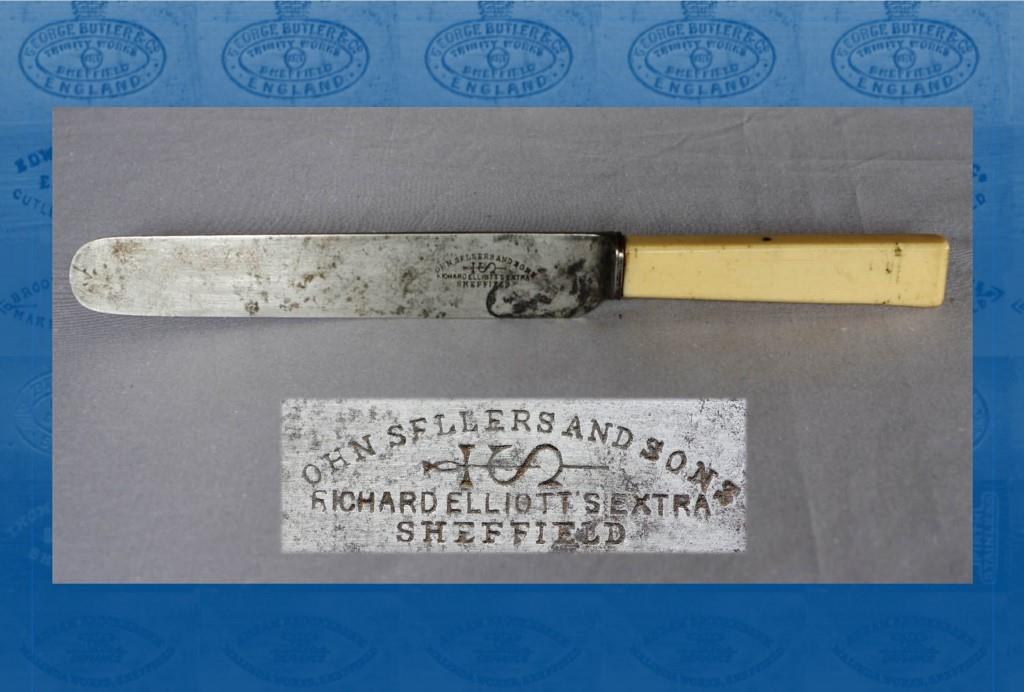
© Ken Hawley Collection Trust - K.0979
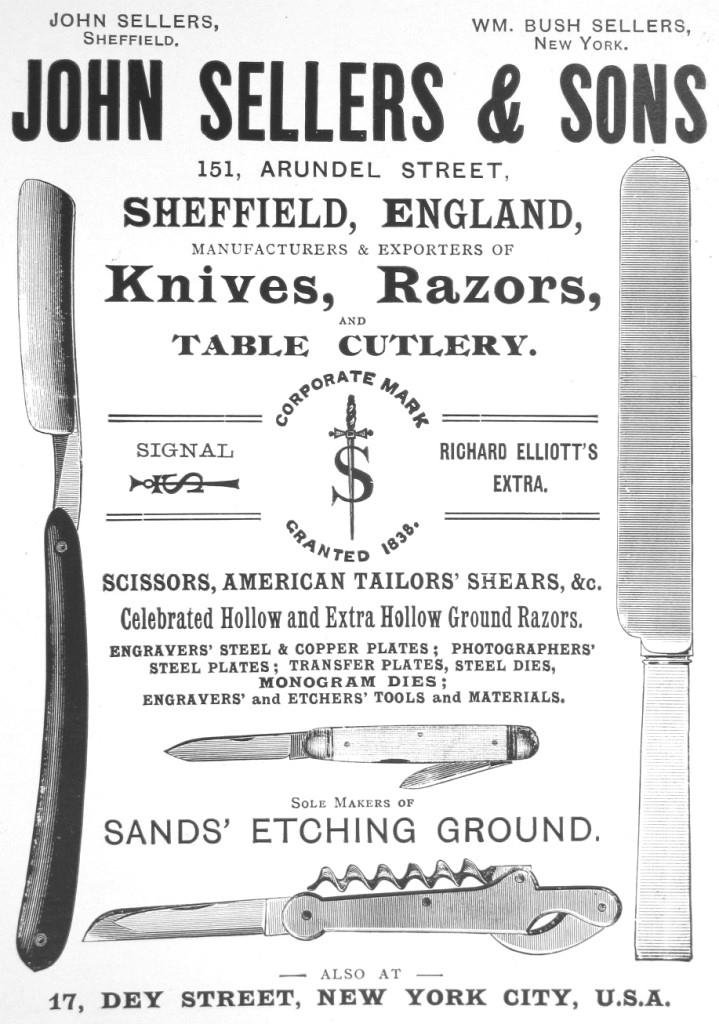
The firm dated its establishment from 1820. The founder was John Sellers (c.1793-1855). Little is known about his early life, except that he was born at Norton, Derbyshire. The baptism of John Sellors (sic) at Ashford, Derbyshire, on 26 May 1793, may be relevant: if so, his parents were Richard and Bridget. John Sellers did not appear in Sheffield directories until 1833, when he was making pen-knife blades in Rockingham Street. He was enumerated as a cutler in the Census (1841) at Rockingham Street, where he was living with his wife, Hannah née Bush (whom he had married in Sheffield in 1818). In 1837, the local directory listed him as a pen knife and surgeons’ instrument manufacturer, based at Roberts’ Yard, Earl Street. During the 1840s, Sellers also launched the manufacture of copper and steel plates (and tools) for engravers. This was to become a Sellers’ speciality and eventually included the manufacture of transfer plates, steel dies, monogram dies, photographers’ steel plates, and patent etching ground. Sellers’ corporate mark (granted in 1838) was a dagger entwined with the letter ‘S’.
In 1851, when John resided at Hanover Street, he told the Census that he was a cutlery manufacturer employing ten men. He concentrated on the manufacture of high-quality pen and pocket knives. His display at the Great Exhibition (1851) included ‘Wharncliffe’ and ‘Congress’ knives, the ‘Harewood knife’, ‘Norfolk knife’, ‘Rutland Knife’, ‘Walton fishing-knife’, and ‘Wilkinson knife’. The jurors awarded the firm an Honourable Mention for its cutlery. Sellers’ steel plates and engraving tools also received notice at the Exhibition. John Sellers had invited a leading engraver, Charles Mottram, to work on a machine-ruled steel plate three feet long, in which ‘the sky tint [was] perhaps the most severe test to which a plate can be subjected’ (Great Exhibition … Official Descriptive and Illustrated Catalogue, vol 2, 1851). The steel surface was commendably free from spots or seams – amply demonstrating the superiority of steel over traditional copper plates. These steel engraving plates would soon be adopted by bank note printers.
John had been joined by his sons: William Bush Sellers (1822-1880), Alfred Sellers (1824-1882), and Abraham Sellers (1827-1877). In 1856, William Bush and Abraham filed a patent for ‘an improvement in ever-pointed pencil cases’. A promising trade was developing with the USA. Alfred left for New York, where the firm had opened an office in Pearl Street in 1847. The company displayed its cutlery and machine-ruled steel plates at the New York Exhibition in 1853. Alfred spent about fifteen years in America, where he was also a general merchant and agent for other Sheffield firms, such as tool manufacturer James Howarth.
Hannah died at Hanover Square on 8 December 1853, aged 56. John moved to the suburb of Heeley, with other members of his family. He died at his residence Holly Mount on 5 August 1855, aged 62. The Sellers’ tombstone can be seen in the General Cemetery’s unconsecrated section, near the foot of the stone steps from the Chapel. After his death, the company was restyled as John Sellers & Sons. In 1860, it relocated to a three-storey cutlery ‘wheel’ in Arundel Street. In the following year, William Bush Sellers told the Census that the firm employed 26 men, sixteen boys, three women, and a girl.
Alfred withdrew from the partnership in 1870 and returned from the USA. However, he remained active in business in Sheffield and was a director of the Sheffield Brick Co. Sellers’ engraving plates remained popular with American bank-note printers, and so the firm continued to staff a New York office. Alfred’s replacement in America in 1873 was his brother Abraham. In 1875, Abraham was joined by his son, William Bush Sellers (1859-1938). However, Abraham died from chronic gastritis at Halsey Street, Brooklyn, on 30 March 1877 and was buried in an unconsecrated grave in the General Cemetery three weeks later. He left under £3,000. Within five years, his two brothers were buried in the same cemetery: William Bush, Holly Mount, Heeley on 15 May 1880, leaving under £4,000; and Alfred, Victoria Villa, Heeley, on 3 June 1882, in Harrogate, leaving £2,175 (Sheffield Daily Telegraph, 5 June 1882).
The management passed to Abraham’s sons, John Sellers (1851-1913) and William Bush Sellers. John managed the Sheffield factory, where the workforce was said to have increased to about a hundred towards the end of the century (Sheffield & Rotherham … Up-to-Date, 1897). Besides engraving plates and tools, Sellers continued to manufacture (or factor) fine table cutlery, pen and pocket knives, sportsman’s knives, and hollow-ground razors. Another speciality was silver and electro-plated wares, besides nickel-silver spoons. In 1890, Sellers’ acquired the assets and ‘EXTRA’ trade mark of neighbouring table knife maker Richard Elliott. William Bush Sellers was the resident agent in New York at first John Street, and then Dey Street, where he sold engraving plates. He also imported items of cutlery, which were able to breach the American tariff. These included razors, which were stamped with another of the firm’s marks, ‘SIGNAL’.
John Sellers died at his residence Elm Grove, Parker’s Road, on 17 September 1913, aged 63. His burial was at Fulwood, His estate was valued at £7,683. In 1914, the firm apparently employed about 170 workers (Whitaker’s Red Book, 1914). John Arthur Sellers (1877-1947) – John’s son and great-grandson of the founder – became the senior partner and managing director. In 1917, his car skidded on the Ecclesall Road, mounted the pavement, and knocked down and killed a 45-year-old married man. Sellers was arrested and charged with manslaughter, because he had evidently been speeding and was the worse for wear. At the scene, Sellers stated that he had imbibed only three drinks, to which one witness had countered: ‘Well, they must have been big ones’. In court, Sellers admitted drinking two ‘small’ rums and a whisky, but argued that his speed was no more than 15 miles per hour. He was found not guilty and the case was dismissed (Yorkshire Post, 26, 27 July 1917).
In the early 1920s, John Arthur moved to The Hall, Castleton in Derbyshire, where he became ‘well known for his public work in the High Peak’ (Sheffield Daily Telegraph, 14 February 1931). A Conservative local councillor and Justice of the Peace, he was involved with Castleton parish church, sheepdog trialling, and the British Legion (Derbyshire Times, 17 December 1932). He operated the Sheffield business with the help of his managers: notably, Arthur Sellers (1869-1948), who was the son of Abraham Sellers (1827-1877); and Harold Victor Sellers (1887-1952), the son of John. However, Harold left England in about 1920 and settled in Tasmania, where he became a motor agent. Abraham remained as the factory manager.
In New York, William Bush Sellers and his Brooklyn-born son, William Edward Sellers (1882-1964), handled the firm’s American trade, which mostly involved steel engraving plates. In the US Census (1920), each classed their occupation as ‘steel engr’; in the Census (1930), it was ‘steel plates’. William Bush had ended his connection with the Sheffield firm in about 1926, though his son may have continued to import from Sheffield. In 1935, it was reported that John Sellers & Sons was still supplying the US Treasury with the steel for the manufacture of the blocks for printing dollar bills (Sheffield Daily Independent, 21 December 1935). William Bush Sellers died from cancer and heart failure at his residence at Brooklyn, New York, in 1938 (Sheffield Daily Independent, 26 January 1938). He was buried at Mount Olivet Cemetery, New York. William Edward Sellers died in Brooklyn on 26 January 1964. His estate in England was valued at £8,000.
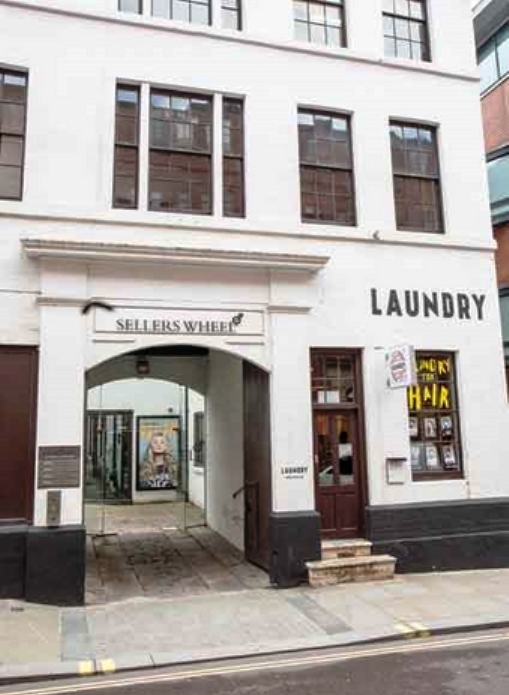
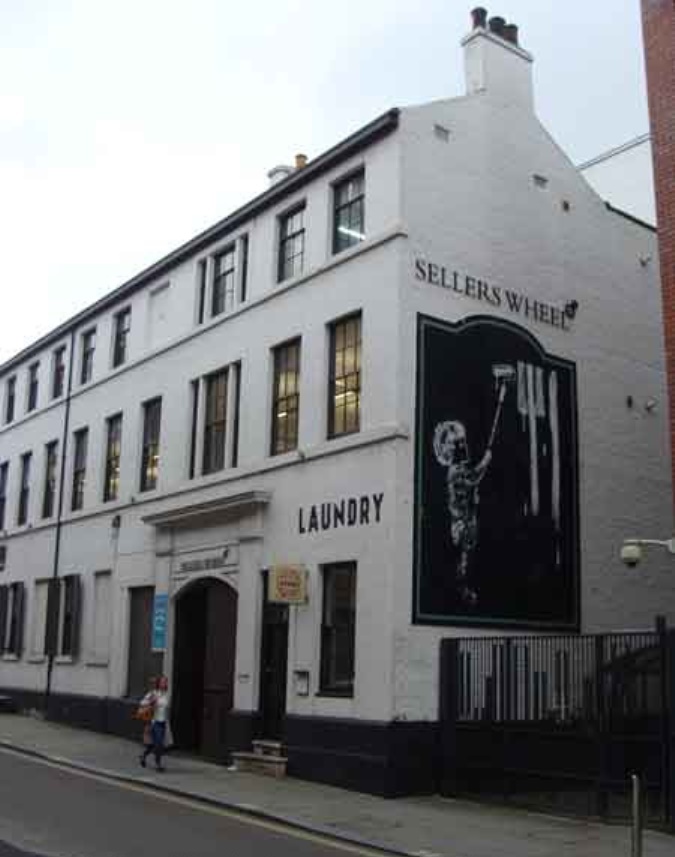
In 1939, John Arthur Sellers, ‘cutlery manufacturer’, was living at Chapel-en-le-Frith, with his wife, Edith Eleanor Cecil née White (1903-1985). His last address was Dimminsdale, Saltergate, Bamford. He died on 30 January 1947, leaving £6,733. His executors were Abraham Sellers, ‘engravers plates manufacturers manager’, and his widow, Edith. Unfortunately, Abraham died on 28 March 1948, aged 78, leaving £5,047. The business lacked a manager, until Edith met James Hugo Ufton (1911-1997). He was a Derbyshire man, who had been a works manager in the timber trade. They married in 1952, when Edith’s husband changed his name to Hugo Ufton-Sellers. He managed the factory at Arundel Street and was able revive its business connections with currency printers eager to obtain supplies of engraving plates. According to one report, Edith and Hugo became ‘prominent in social circles in the High Peak district of Derbyshire … notably as keen riders to hounds. Under their joint direction, the firm … flourished, growing steadily rather than spectacularly’ (Director, vol. 24, 1971). In the 1960s, the couple moved to Brooke, near Norwich. Hugo continued to supply customers with steel and etching ground, but John Sellers & Sons ceased business in 1975 – a private company at No. 151 Arundel Street to the last. Sellers’ Wheel on Arundel Street still stands and has been renovated with the usual mix of student accommodation and bars and coffee shops. Examples of Sellers’ engraved copper and steel plates, and engraving tools, can be found in several museums and art collections.