



John Harrison & Company Ltd

Advertisement from White's 1856 Directory
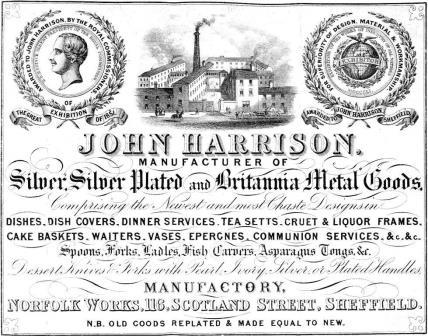

Trade reports stated that this business began in 1820. However, it was not until 1833 that John Harrison & Co was listed in a directory and registered a silver mark in Sheffield. Based in Norfolk Works, Norfolk Lane, it manufactured German silver and Britannia metal wares. The owner was John Harrison, who was born in Sheffield in about 1797, and lived in Chapel Street, Bridgehouses. In 1829, he married Miss Harriot Maleham, Arundel Cottage, Bridgehouses. By 1841, his address (both factory and home) was Norfolk Works, No. 113 Scotland Street.
John Harrison’s claim to fame is that on 13 June 1843 he became the first Sheffield manufacturer to take out an electro-plate licence (the fourth granted in the UK) from the patent-holder, Elkington of Birmingham. Less than a month later, Harrison was advertising in the local press, ‘Re-plating Old Plated Goods, with Elkington’s Patent, making them equal to new.’ Harrison developed a range of tableware for home and export, including dessert knives and fish carvers. He registered a second silver mark from Norfolk Works, Scotland Street, in 1844 (further marks were registered in 1866, 1880, 1883). The business soon had competitors, including Walker & Hall (part-founded by George Walker, whom Harrison had employed as an assistant and sent to Elkington’s factory to learn electro-plating). But Harrison’s company prospered: it was a regular advertiser in the trade press and had London and Glasgow agents. John Harrison displayed a wide range of electro-plated products at the Great Exhibition (1851). One of his sons, John Maleham Harrison (1845-1872), joined the business; and his eldest son, William Wheatcroft Harrison, founded his own enterprise.
John Harrison later lived in Winter Street, within walking distance of his factory. In 1861, he employed 103 workers. He died at his home on 6 December 1863, aged 66, and was buried in Fulwood. He left under £35,000. Executors took over the business, until John M. Harrison came of age (William W. Harrison was already running his own enterprise). John M. Harrison, however, died at Bridlington Quay on 15 April 1872 (aged only 26) and was buried in Fulwood. He left an estate valued at under £18,000. At that time, the business employed 97 workers. In 1872, the company adopted limited liability, with £7,500 called-up capital. Its manager was Henry Eades. The Ironmonger (12 November 1887) told its readers that Harrison’s Scotland Street works: ‘are most complete, 200 hands being steadily employed, and everything, from the rough work to the final engraving and chasing, being done on the premises. Business is well maintained … [and] for the convenience of their London trade the company have a show-room at 34 St Mary Axe, and they have this year added another show-room to that already existing at the Sheffield works’. Actually, the business performed poorly and in the early 1880s began auctioning its stock (Sheffield Independent, 13 June 1882). Matters evidently did not improve and in 1889 Norfolk Works was liquidated, with the sale of its working plant, 70 tons of dies, and showroom fittings (Sheffield Independent, 19 October 1889). The Scotland Street premises, and company assets were acquired by Richard Richardson, who became Harrison’s ‘successor’.